The Most Underrated Cities in Europe Worth Visiting
The most underrated cities in Europe are the ones a title year has already left behind, or a famous neighbor keeps overshadowing, and the eight below are picked on those two tests rather than on how well they photograph.
That distinction earns its keep. “Underrated” usually means cheap and still quiet, which is a description with an expiry date. What I looked for instead was a working cultural calendar, a collection you can actually spend an afternoon in, and enough of a local audience that the city does not fold up in November.
Five of the eight have held a European Capital of Culture title. Two are holding one right now. The other three are second cities behind a capital that takes every headline, and one of them has a UNESCO World Heritage monument standing in an open square with no ticket, no rope and no queue.
Key takeaways
- Oulu in Finland and Trenčín in Slovakia are the 2026 European Capitals of Culture, so this autumn and winter are the busiest months either will have for a decade.
- Chemnitz, Kaunas and Plovdiv kept the venues their title year paid for. That is the argument for going soon.
- Olomouc, Trieste and Gijón are second cities that nobody plans a trip around, which is the problem and the reason.
- None of the eight needs more than three nights, and all eight sit inside the European Union under the same 90-day rule.
Two reasons a good city stays underrated
A European Capital of Culture year is the most reliable version of the first reason. The designation lasts twelve months, it comes with a programming budget a mid-size city could never raise on its own, and it leaves behind venues, an events team that has learned how to run things, and an audience that has got into the habit of going out.
Then it ends. The international press goes home, and the city sells its tickets to the people who live there.
The European Commission’s own page for the 2026 pair gives you the scale of what gets built and then forgotten: roughly 500 events are planned for Oulu across the year, under three themes the Commission translates as Brave Hinterland, Cool Contrasts and Wild City. Trenčín’s year runs under a slogan, Awakening Curiosity, and it reaches out into the surrounding region rather than stopping at the city limit.
The second kind of underrated city has the opposite problem. Nothing is missing except attention, because the capital a few hours away absorbs all of it. Olomouc is a two-hour hop from Prague and almost never appears on the same itinerary. Trieste sits at the end of Italy that people treat as a border rather than a destination. Gijón is in the part of Spain where it rains.
Worth saying plainly: none of these places is undiscovered, and the phrase hidden gem has never helped anyone choose a trip. Olomouc has a UNESCO column in its main square and students filling the place on a Tuesday. Underrated here does not mean empty. It means never the reason someone books a flight.
If the appeal is doing less and staying longer, the case for that is made in our guide to what slow travel actually means. Three nights in one of the cities below will teach you more about the country than three capitals in three days.
Trenčín and Oulu: the two title years running now
The first thing worth knowing about Trenčín is about 1,900 years old. Carved into the rock below the castle is a Roman inscription from 179 AD, left by soldiers who had just beaten the Germanic Quadi, and the city’s tourism office points out that it counts as one of the few written records of Roman presence in Central Europe. You pass it on the way up to the castle, which is not a provincial ruin either: the same office ranks it with Spiš and Devín as one of the most extensive castle complexes in Europe.
The title year has done what title years are supposed to do, which is fund the things a normal municipal budget cannot. Trenčín 2026’s program includes a Roman exhibition that runs to 17 January 2027 and a set of free public-art interventions on the city’s underpasses. It also sits on the main Bratislava to Košice rail corridor, so it slots into a route instead of demanding its own trip, and the spa town of Trenčianske Teplice is a short hop away, with springs first recorded in 1247.
Oulu is the harder sell and the better trip.
It is a northern port on the Bothnian Bay, and the title is shared with 39 surrounding municipalities, which is why the program spreads across a region rather than one downtown. The autumn schedule is dense enough to fill four days without repeating a venue. The Kuutar Garden, an immersive installation by Jakob Kudsk Steensen, has taken over the Kivisydän car park beneath the city center until 30 November, and tickets range from nothing to 10 euros. Lumo Art and Tech, a ten-day festival of light, sound and digital work, runs 13 to 22 November. Björk Orkestral plays in November and December with tickets starting at zero and topping out around 17 euros, and the city orchestra’s Beyond the Sky starts at 19 euros.
This is also the city that came up with the Air Guitar World Championships, which tells you something about how Oulu treats culture: seriously, and without a lot of ceremony. Sauna is the other local institution, including the raft version on the river.
Chemnitz and Kaunas: what a title year leaves behind
Chemnitz held the title in 2025 along with Nova Gorica in Slovenia, and the year is finished, which makes it a fair test of whether the money left an afterglow. The answer is mostly yes. The Hartmannfabrik, which served as the visitor center, is now opened by volunteers every Saturday from 10 am to 4 pm. The PURPLE PATH, a sculpture and art trail that spreads across the whole region instead of clustering downtown, is still standing.
Underneath that is a city that was once the richest in Germany, and it still has the buildings to prove it: an industrial museum that the city’s tourism office calls the most vivid testimony to Saxon industrial history, a state archaeology museum, and Villa Esche, a house Henry van de Velde designed down to the cutlery. Chemnitz is not pretty in the postcard sense. It is interesting in a way that postcards never are.
Kaunas is the reverse case. The title came in 2022, and the recognition arrived a year later, when UNESCO inscribed Modernist Kaunas on the World Heritage List, covering the interwar years from 1919 to 1939. The numbers explain the decision. Roughly 1,500 of the 6,000 surviving interwar buildings sit inside the listed area, and the city’s footprint grew sevenfold during the two decades it served as Lithuania’s provisional capital. Two districts carry the listing: Naujamiestis, the grid-planned New Town, and Žaliakalnis, the garden suburb on the hill above it.
Almost nobody visits Kaunas for the interwar architecture, which is the whole problem, because it is the best-preserved concentration of it in the region. There are more places in that situation in our guide to lesser-known World Heritage sites.
Plovdiv: three wine weekends and a Roman stadium
Plovdiv was the 2019 European Capital of Culture alongside Matera, and the useful legacy is a calendar that runs in the shoulder months. Urban Wine Fest falls on 23 and 24 October. Plovdiv Jazz Fest runs at the Boris Hristov House of Culture from 6 to 8 November. The Young Wine Festival follows from 20 to 22 November. Ten weeks, three reasons to be in Bulgaria in the off season.
The city itself carries more history than most people expect. Its tourism office lists the Roman stadium, the ancient theater, the Bishop’s Basilica of Philippopolis and the architectural reserve of Ancient Plovdiv among its headline sites, plus the Kapana district where the bars are, and the Roman road and forum sit in the middle of a working city rather than behind a fence. The same office also bills Plovdiv as the best wine capital in Europe for 2025, which is marketing. Weigh the three wine weekends more heavily than the award.
Olomouc: the World Heritage column nobody queues for
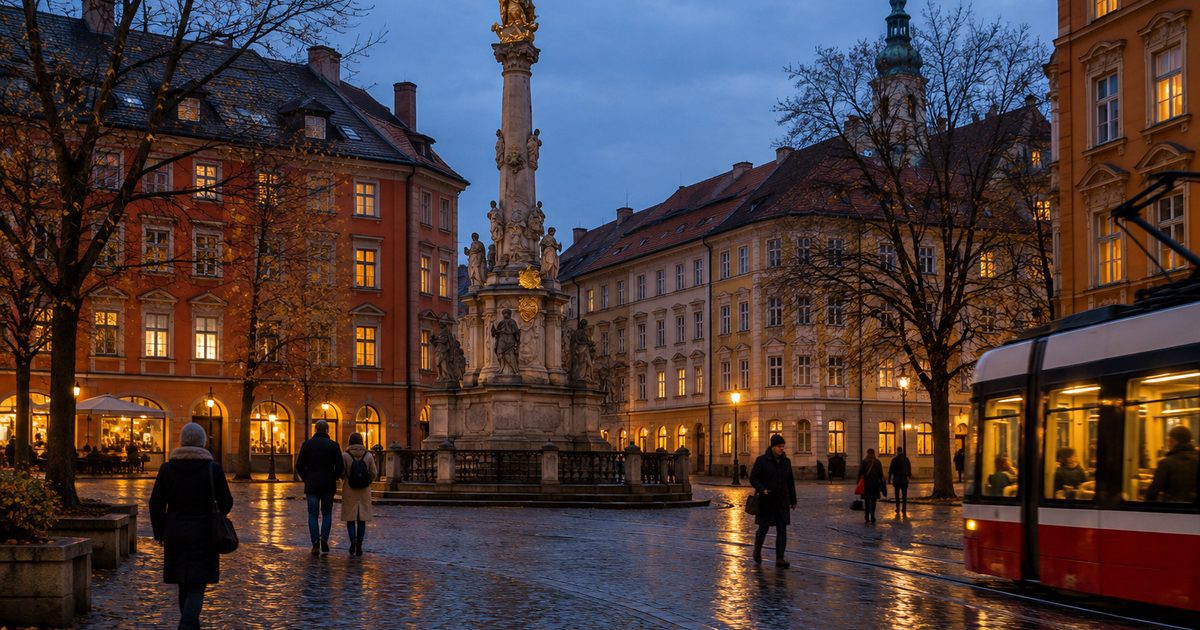
Olomouc has a UNESCO World Heritage monument standing in its main square and still loses every Prague-bound itinerary. The Holy Trinity Column is a little over 32 meters high on a round base 17 meters across, designed by Václav Render with sculpture by Ondřej Zahner, and UNESCO describes it as the most outstanding example of a monument type found only in Central Europe. It went on the list in 2000, it is protected under Czech law as a national cultural heritage site, and the surrounding historic center serves as its buffer zone.
There is no ticket, no turnstile and no queue, because it stands in the middle of a university town that simply uses its own square. That is the entire argument for going, and it takes about four seconds to make.
Trieste: the Habsburg port that never quite feels Italian
Trieste is the one on this list I would defend hardest. It is Italian, it spent centuries as the Habsburg Empire’s outlet to the sea, and it has lived on the edge of three cultures long enough that the coffee, the architecture and the cooking all feel like they belong somewhere else. Italy’s national tourism board describes it as a meeting point of Latin, Slavic and German influences, and it is hard to argue with the description once you have ordered a coffee standing up at a counter that has been there since the nineteenth century.
The literary reputation is not a marketing invention. Italo Svevo was born in Trieste, and Umberto Saba, another writer from the city, said it had a surly grace, which remains the most accurate three-word description of the place I have read. The Teatro Lirico Giuseppe Verdi dates to 1800, was built along the lines of La Scala in Milan, and still runs an opera and ballet season.
If the sea is your reason, the Barcolana regatta takes place on the second Sunday in October. This year’s has just gone, so a 2027 trip is the next practical one.
Gijón: Asturias without the coach groups
Gijón is in Asturias, which means it rains, which means the crowds go south instead. The trade is worth making. The old quarter, Cimadevilla, sits on the hill of Santa Catalina beneath Eduardo Chillida’s Elogio del Horizonte, and the Roman baths at Campo Valdés were left behind by the Fourth Macedonian Legion. Across town the Laboral City of Culture, described by Spain’s national tourism board as one of the largest civil architectural ensembles in the country, is a good wet-afternoon fallback.
The rest is local. Cider poured from a height in the cider houses along Paseo Begoña, fabada when the weather turns, a beach a short walk from the old town, and a film festival every November: the Gijón International Film Festival runs 13 to 21 November 2026. Spain’s tourism board also lists Gijón as a former shortlist entry for the European Commission’s EDEN program, which says more about how the city handles visitors than about how many it gets.
The eight, side by side
Blunt version, because a list of eight is only useful if it helps you cross some of them off. The nights column is how long I would give the city before moving on.
| City | Country | Go for | Skip if | Nights |
|---|---|---|---|---|
| Trenčín | Slovakia | A 179 AD Roman inscription, one of Europe’s largest castles, free title-year art across the city | You want a capital city’s nightlife | 2 |
| Oulu | Finland | Title-year programming through December, sauna culture, northern light in winter | You want warmth and a beach holiday | 3 |
| Chemnitz | Germany | Industrial history treated seriously, a sculpture trail across a whole region | You only like towns that look the way they do on postcards | 2 |
| Kaunas | Lithuania | Interwar modernism at World Heritage scale, in two walkable districts | You want a resort town | 2 |
| Plovdiv | Bulgaria | Roman remains in a living city and three wine festivals in ten weeks | You want everything within one square mile | 3 |
| Olomouc | Czechia | A UNESCO square with students in it and nothing to queue for | You are on a Prague weekend and refuse to leave it | 2 |
| Trieste | Italy | Habsburg coffee houses, a genuine border, an opera house older than most of Italy | You want the Renaissance hill-town version of Italy | 2 |
| Gijón | Spain | Cider culture, Roman baths, a northern coast without the crowds | Rain would ruin the trip for you | 2 to 3 |
On the paperwork, there is good news and one thing to expect. All eight cities are in European Union countries, so a U.S. passport and a two-week trip do not require a visa or an application of any kind. What you will meet is the Entry/Exit System, which registers your entries and exits digitally, fingerprints and facial image included, and gradually replaces the passport stamp. The European Commission’s official page for the Entry/Exit System lists Bulgaria, Czechia, Finland, Germany, Italy, Lithuania, Slovakia and Spain among the countries using it, and it confirms the rule underneath: 90 days in any 180-day period, counted across all of those countries together rather than one at a time.
Getting between them is easier than the map suggests. Trenčín, Olomouc and Chemnitz all sit on rail corridors that connect bigger cities, which makes them stops rather than detours. Oulu is the outlier and always will be. If you would rather drive part of it, and use the vehicle as your accommodation while you do, the place to start is our beginner’s guide to boondocking in an RV off grid.
Two things change faster than anything else here. Festival dates move, and title years end. Trenčín’s program and Oulu’s are both scheduled to run out with 2026, so confirm dates on the city’s own tourism site before you book, and treat every date in this piece as a starting point rather than a promise.
Underrated European cities FAQs
What is the most underrated city in Europe?
Kaunas, if you want the answer to be defensible rather than charming. It has a UNESCO World Heritage listing covering roughly 1,500 interwar buildings, a walkable core, and almost no international tourist traffic, which is a combination that is disappearing across the continent. Olomouc is the better answer if you want somewhere you can reach easily and enjoy in a day.
Are these cities cheaper than Paris or Rome?
Accommodation and restaurants outside a capital are normally a fraction of the capital’s price, and Oulu is the exception in this group: it is a Finnish city in a title year, so book early or pay for the delay. Everything else is cheap by western European standards. Rather than trust one daily number, build the budget from your own dates and the specific tickets you want, which is the method in our guide to traveling the world on a shoestring budget.
When is the best time to visit Oulu?
Now through December, if you want the Capital of Culture program while it is still running, since the title year ends with 2026. Summer is the other answer, for the light and the archipelago. Winter is a commitment rather than a compromise, and the events on the calendar are built around it.
Do I need a visa or a travel authorization for these countries?
For a short trip, a U.S. passport is enough, with one system to watch. The EU’s Entry/Exit System is already registering travelers at the border, and the separate ETIAS travel authorization is the piece still in the pipeline. Check the status on the EU’s official travel site and the U.S. Department of State’s country page before booking rather than relying on a headline, because both have moved before.
Can I combine more than one of these cities in one trip?
Yes, and the map helps. Trenčín and Olomouc are on the same north-south rail corridor with Vienna and Prague at either end, so the pair makes a natural week. Chemnitz is close enough to Dresden and Leipzig to slot into a German route. Kaunas and Plovdiv both need their own leg, which is exactly why they are still quiet. The method for costing a region you have never traveled in is in our guide to planning a budget trip to Southeast Asia, and the arithmetic carries over to any of these cities.
The short version
Pick one, give it three nights, and go in a month when the city is awake. Trenčín and Oulu through December, Plovdiv in wine season, Gijón when the film festival is on. Sort the rest later. The only two things to verify against today’s calendar are the festival dates and the ticket prices.
Some links in this guide may be affiliate links. We keep them separate from sponsored content, and you can read how and why in our post on separating affiliate content from paid sponsorships. This is not professional advice — always confirm current rules with the relevant authority before you act on it.