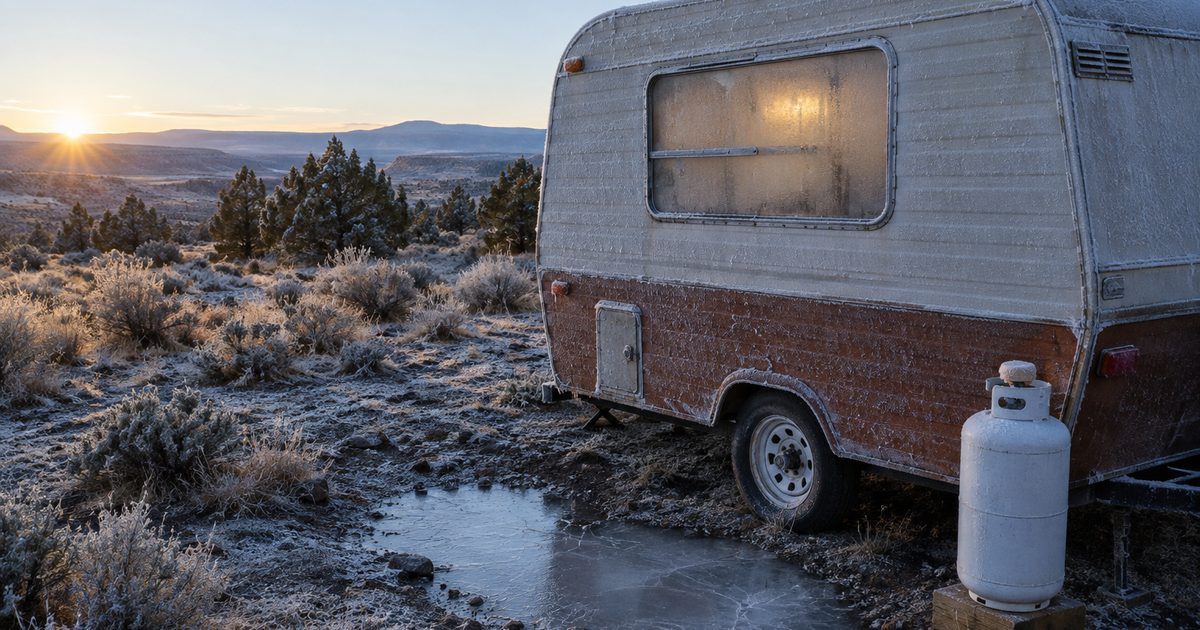
How to Winterize Your RV for Off-Grid Living
Winterizing for off-grid living is not one job, it is four, because four separate systems fail in the cold: water, batteries, propane and waste. Draining the lines is only the first of them, and it is the one most people finish before they stop.
That distinction matters more off grid than it does in a campground. On a pedestal you have water at the tap, power at the post and a dump station on the way out. Parked on public land in January, you have none of those, and the failure modes change accordingly. A frozen line is annoying. A lithium bank that will not accept a charge until noon is a week-long problem.
Treat this as a general guide rather than a substitute for your owner’s manual or a licensed technician. Propane and electrical work should be confirmed with a professional, and every land-use rule below re-checked with the managing agency before you drive out. Those are set locally, and they change.
Key takeaways
- Water is the cheapest system to protect and the most expensive to repair. A split line or a cracked water heater costs far more than the two hours it takes to do this properly.
- Batteries are the real off-grid limit, not the cold itself. LiFePO4 should not be charged below roughly 25°F unless it has internal heating, and those are short, dark days for solar.
- Propane lasts days, not weeks, in hard cold, and a cylinder is never filled past 80 percent of capacity for a reason.
- Empty the tanks before you park, not after. A full black tank that freezes is a different category of problem.
What winterizing protects, and what it cannot fix
Water damage is the whole reason this ritual exists, and the arithmetic is lopsided. Water expands roughly nine percent as it freezes, and it does that inside rigid PEX, a plastic pump housing and a porcelain-lined tank. The parts that split are usually the cheap ones. The parts that fail because of the cheap ones are not.
Insulation slows the problem down and does not solve it. That is the honest version of the advice you will read everywhere. The RV Industry Association’s guidance on cold-weather camping, which carries its own caveat that procedures differ by unit type and that your owner’s manual governs, suggests cutting insulated foam board to fit between the frame and the base as a barrier under the tanks, water lines and floor, and it notes plainly that RV skirts help but provide less insulation than people assume. Useful. Not a substitute for getting the water out.
The one thing winterizing cannot fix is a rig that was never built for the cold. If your underbelly is unheated and your water lines run below the floor with no heat trace, no amount of foam board makes that a four-season setup. You are choosing between draining the system and living without running water, and there is no third option that does not involve a heated, enclosed, powered space.
If you are new to parking without hookups at all, start with our beginner’s guide to boondocking in an RV off grid, then come back to this one, because everything here assumes you already know how to find a site and how to leave it clean.
Air, antifreeze, or both: pick your method
There are two ways to get water out of the system, and the argument between them is mostly about what you are doing next. Keystone RV’s own winterization guide lists the tools as an air compressor, a blowout plug adaptor, RV or marine-grade antifreeze (explicitly not the automotive kind) and a screwdriver, which tells you they expect most people to use both methods in sequence rather than choosing.
| Compressed air | RV antifreeze | |
|---|---|---|
| What it removes | Most of the standing water in the lines | Whatever is left, by displacement |
| Cost | Compressor and a blowout plug, one-time | A few gallons, every year |
| Time for a travel trailer | 30 to 45 minutes | Another 30 to 45 minutes |
| Spring work | Almost none | Flush and sanitize the lines before you drink from them |
| Weak spot | Water pockets sit in low spots and in the pump | Misses nothing, but you taste it if you rush the flush |
Air alone is faster and leaves nothing behind to flush. Antifreeze alone protects the pump and the traps in a way air cannot, because air does not push water out of a P-trap or out of the pump impeller. Doing air first and then antifreeze gives you the smallest possible volume of antifreeze in the system and the shortest spring flush.
That volume is the reason to bypass the water heater, and forgetting to is the single most common way people double the cost of their own winterization: the heater’s tank fills before the lines do, and you spend six to ten gallons on one appliance.
The step order, and the step people skip
The order is not arbitrary. It runs from the largest volume of water to the smallest, and every step is easier when the one before it has already happened.
- Drain the water heater. Outside access panel, on most rigs near the kitchen side.
- Open the low-point drains underneath, usually near the water heater, and let the system gravity-drain.
- Open every faucet inside and out, including the outdoor shower, so air can get in behind the water.
- Drain the fresh water tank from the valve or cap on the undercarriage.
- Close the faucets before you pressurize anything.
- Connect the air compressor to the city water connection with a blowout plug adaptor.
- Blow the lines out one faucet at a time until nothing but air comes out, then move to the next.
- Disconnect the compressor and turn the water heater bypass valve to the winterize position.
- Draw antifreeze through the pump using the pick-up tube, opening each faucet and flushing the toilet until pink runs.
Two practical notes on step 6 and step 7. Regulate the compressor low. You are trying to move water, not pressure-test a plastic system, and the fittings and the pump housing are the weakest parts in the assembly. And do not skip the outdoor shower and the toilet sprayer, which are the two outlets people forget and the two that burst most often, because they hang lowest on the frame.
The step people skip is step 8. The bypass valve is usually behind an access panel near the pump or in the convenience center, and if you cannot find it, the trick is to run the pump and listen. If you bypass nothing, you fill a six-gallon tank with antifreeze you then have to flush out in spring, and you risk the heater’s anode and fittings sitting in it all winter.
Batteries decide whether you can stay off grid
This is the section the campground guides leave out, because on a pedestal your battery is a backup. Off grid in winter it is the whole system, and cold changes what it will accept, not just what it will give.
Lithium iron phosphate behaves very differently from the lead acid it replaced. Battle Born’s technical guidance puts the discharge floor at roughly minus 4°F, which is well past anything you will camp in comfortably, but states that LiFePO4 should not be charged below approximately 25°F unless the battery has internal heating. The battery management system will block charging outside safe limits on its own, which protects the cells and simultaneously means you can wake up, see sun on the panels, and watch your state of charge go nowhere until the battery warms.
Lead acid fails differently and more dangerously. U.S. Battery’s cold-weather guidance is blunt about the mechanism: a fully charged flooded battery has a freezing point below minus 80°F, while a discharged one freezes at 20°F or higher. The lesson is not that lead acid is better in the cold. It is that a discharged lead acid bank can crack its own case, so the one thing you must not do is park it at 50 percent and walk away.
Three things follow from that, and none of them are expensive. Insulate and, if you can, heat the battery compartment. Move to heated batteries if you are buying new and you intend to use the rig in winter. And accept that December and January solar yield is a fraction of June’s, which is the arithmetic in our post on what an RV solar setup actually costs and what to size for — a system sized for a June trip in Arizona will not carry a December trip in the same place, let alone further north.
For storage rather than camping, both sources point the same direction: charge to full before you park it, and keep it there, whatever the chemistry.
Propane in the cold
Two propane facts explain almost everything that goes wrong in a winter rig.
The first is that propane stops being a gas in the cold. The Utah State Fire Marshal’s LP-gas filling guidance, which is written against NFPA 58, notes that liquid propane boils at minus 44°F to produce vapor. As the tank cools, the vapor pressure that pushes gas to your furnace drops with it, so a cylinder that runs a furnace fine in October can appear to be nearly empty in January while still holding liquid. It is not empty. It is cold. This is why the same source insists on transport and storage rules that most people have never read: never store or transport a full or empty cylinder in the passenger space or living area of your RV, and never store one inside a house, building or garage. Spare cylinders go outdoors, upright, on a non-combustible base with the outlet capped or plugged.
The second is the 80 percent fill rule. Cylinders are filled only to 80 percent of capacity, to leave room for the liquid to expand as it warms, and the same document is explicit that rounding up the meter after a cylinder is full overfills it and that it is unlawful for a customer to ask for an overfill. That vapor space is not slack. It is the safety margin. Cylinders also expire: DOT cylinders must be requalified 12 years after manufacture and every five years after that, and a cylinder without an overfill protection device has been barred from refilling since April 2002.
The practical version: the RV Industry Association warns that propane will last only a few days in extremely cold weather, which is the number people plan around badly. Three weeks in January is not one fill. You are hauling spare cylinders or parked near a refill station. On handling, the US Forest Service is direct: read the instructions that came with the appliance, and never leave a propane stove or grill burning unattended.
Tanks, dump valves and gray water
Empty the tanks before the rig gets cold, and empty them somewhere legal. This is less about convenience than about what freezing does to a tank that is full or nearly full.
The RVIA’s guidance is to drain black and gray tanks before the trip and to add roughly a quart of RV-specific antifreeze to each, specifically to protect the dump valves, which are the parts that freeze first and cost the most to replace. Automotive antifreeze is not a substitute and should never go in a potable water system.
If you are living in the rig rather than storing it, the tank problem moves to the gray tank, because you keep producing gray water every day. Off grid with no dump station, that tank fills, and it fills faster than people expect once you are cooking and washing up inside instead of outside. A frozen gray tank with a quarter inch of ice in the bottom is survivable. A gray tank frozen solid with forty gallons in it is not something you can thaw with a hair dryer in an afternoon, and the expansion can split the tank or the valve body.
The other winter trap is the sewer hose, which the RVIA recommends wrapping in insulation or heat tape to stop ice dams forming inside. The drain pipes feeding the tanks get the same treatment: foam insulation, and heat trace for extended below-freezing stays, which needs a power source and brings you back to the battery question.
Storing it or living in it
These are two different jobs and most people conflate them, then do neither well.
Storing it is a one-afternoon job and it fails in exactly three places: the water system, the batteries and the refrigerator. That third one is the one nobody expects. The RVIA notes that the refrigerant in a propane or electric refrigerator is a pressurized solution including ammonia and hydrogen, and that below roughly 20°F it can gel and permanently clog the coils. The fix is almost free — remove the outside access cover and tape over the top two vent slots from the inside of the cover, so the adhesive stays off the exterior.
One more storage detail worth five minutes: stabilizing jacks can freeze to a concrete or paved pad, so put blocks of wood under them and you will be able to lift the jacks and pull forward in spring. And pull the food, the liquids and anything that would expand in a freeze.
Living in it costs money and it costs condensation. You are running heat against a shell with almost no thermal mass, in a space where every shower and every pot of pasta adds moisture to the air, and that moisture lands on the coldest surface in the rig — usually the window glass or the wall behind your head. Insulating window film and a vent cushion are cheap and they help, but the real fix is ventilation: crack a vent, accept the heat loss, keep the humidity down.
The RVIA’s cold-weather kit list is worth keeping as a shopping list, because it is built around failure rather than comfort: zero-degree sleeping bags, extra blankets and clothing, five gallons of water stored in a heated space, a gasoline generator, a hair dryer for thawing lines and tanks, batteries, a GPS, solar, cash, and tire chains.
On cost, I am not going to hand you a dealer price, because it varies by market and by rig and I did not verify one. Call two local shops. The parts are cheap: a blowout plug, a few gallons of antifreeze, some foam pipe insulation. The money at stake is on the other side of the ledger, in a split PEX run, a cracked pump housing or a water heater full of ice.
Where you can actually park off grid in winter
Winter narrows your options, and the rules are set locally, so the only reliable method is to check with the managing agency for the specific area before you go.
On BLM land, dispersed camping is generally limited to 14 days within any 28-day period, with the caveat that the Bureau states stay limits vary by state and field office, and that after you reach the limit you must move to a new location, often at least 25 to 30 miles away. Dispersed camping is also defined as recreational use only, not long-term living. The same page sets out the practical rules: stay on designated roads, do not leave personal property unattended for more than 10 days, camp within 150 feet of a designated route, keep at least 200 feet from lakes, rivers and streams, and avoid camping within one mile of a campground, trailhead or picnic area.
The genuine exception, and it is the one winter campers actually use, is the Long-Term Visitor Area. The BLM manages LTVAs in California and Arizona where winter visitors can camp for up to seven consecutive months with a permit. If your plan is January through March somewhere warm and dry, that is the mechanism, and it is why the Quartzsite and Yuma areas fill the way they do.
On national forest land, campgrounds close seasonally and dispersed camping is the fallback, but winter access is the real constraint rather than the rule book. Gates close, roads go unplowed, and a spot that is a two-mile drive in July becomes a snowshoe.
Still deciding what to live in? The honest comparison is our post on what nobody tells you before you start van life, and the build is covered in converting a cargo van into a livable space. A van is easier to heat and much harder to keep water in through a freeze.
RV winterizing FAQs
How much does it cost to have someone winterize your RV?
It varies too much by market and by rig for me to give you a number I would stand behind, and shop rates move. Call two local dealers or mobile techs and ask for a flat winterization price. The parts are trivial, so what you are paying for is labor plus the peace of mind that the water heater got bypassed.
Can I use compressed air instead of antifreeze?
For the lines, mostly yes. For the pump and the P-traps, no, because air does not push standing water out of an impeller housing or a curved trap. The combination is the smaller job overall: blow the lines out first, then run antifreeze so you use less of it.
Will my lithium batteries charge when it’s below freezing?
Not below roughly 25°F unless they have internal heating. The battery management system blocks the charge to protect the cells, so solar may be producing and the bank still will not take it. Insulating the compartment or buying heated batteries is the fix.
What temperature should I winterize my RV at?
Do it before the first hard freeze, not after it. The work itself is comfortable anywhere above freezing, and the risk is not the procedure, it is a single overnight at 25°F while water is still sitting in the lines and the pump.
Is it safe to run the furnace all night off grid in winter?
That depends on your rig and its ventilation, so there is no universal answer — confirm it with your appliance manufacturer and a qualified technician. Never run a propane appliance whose instructions you have not read, and never leave one burning unattended.
The short version
Get the water out, in order, and bypass the water heater. Charge and insulate the batteries, and know that lithium will not charge cold. Count propane in days, not weeks. Empty the tanks before the freeze, not after it. Then check the local rules before you park, because you are the one who will have to move 25 miles when the stay limit runs out.
Some links in this guide may be affiliate links. We keep them separate from sponsored content, and you can read how and why in our post on separating affiliate content from paid sponsorships. This is not legal advice — always confirm current rules with the relevant authority before you act on it.