10 RV Conversion Ideas That Actually Work
The conversion ideas that actually work subtract a system instead of adding one. A bed lift, a roof fan, vented heat, a cassette toilet and a DC-DC charger will beat every clever cabinet you can build.
That judgment comes from three tests, and none of them is looks. Does the idea remove something from your life? Does it earn the weight it adds? Does it still work in year two, when something has started to rattle? Here are ten that pass, and a few popular ones that do not.
Key takeaways
- Weight decides everything else, and most builders never weigh the finished rig.
- NHTSA’s overloading rule treats 100 pounds, or 1.5 percent of gross vehicle weight rating, as enough weight to require a new capacity label.
- A 30-gallon fresh tank is roughly 250 pounds of payload before you load a single pot.
- Every idea below is rated on what it gives back, not on how it looks in a build video.
What makes a conversion idea actually work
The best upgrades are subtractive. A cassette toilet deletes a black tank, a dump-station dependency and the hose you would otherwise store somewhere. A chest fridge deletes the cold air that falls out of an upright every time you open it, which is why it draws less. A vented heater deletes the condensation and the carbon monoxide risk that come with a catalytic unit running inside a sealed box.
The worst upgrades add a fixture, a pump, a wire run and a failure point, and they photograph beautifully. If you cannot say what a modification removes, you are decorating. Weight is the other half of the test, which is why the loaded end of the RV market is a different engineering problem from your cargo trailer.
The ten ideas, and what each one gives back
Weights are for a typical 144-inch wheelbase van or a 6-by-10 cargo trailer. Your numbers will differ, and that is the point of the payload section below.
| Idea | What it gives back | Weight added | Difficulty |
|---|---|---|---|
| 1. Lift-away bed over a rear garage | 20 to 30 square feet of floor by day | 60 to 100 lb | Moderate |
| 2. Roof vent fan with thermostat | Sleep in summer without running the engine | 8 to 15 lb | Easy |
| 3. Vented diesel or propane heater | Dry heat, no condensation, no CO inside | 25 to 40 lb | Moderate |
| 4. Cassette toilet in a wet bath | No black tank, no dump station | 30 to 45 lb | Moderate |
| 5. DC-DC charger plus lithium | Charging while you drive, at full rate | 50 to 70 lb | Moderate to hard |
| 6. Chest fridge on a slide | Lower draw, one access motion | 40 to 60 lb | Easy |
| 7. Swivel seat and removable table | A second room out of the cab | 15 to 25 lb | Easy |
| 8. Magnetic and pegboard walls | Tool and pantry storage without cabinets | 10 to 25 lb | Easy |
| 9. Removable gray water tank | No underbody plumbing, no winterizing it | 10 to 20 lb | Easy |
| 10. Vinyl plank over rigid foam | Warm floor, sweepable, no carpet rot | 80 to 120 lb | Moderate |
The five worth doing first
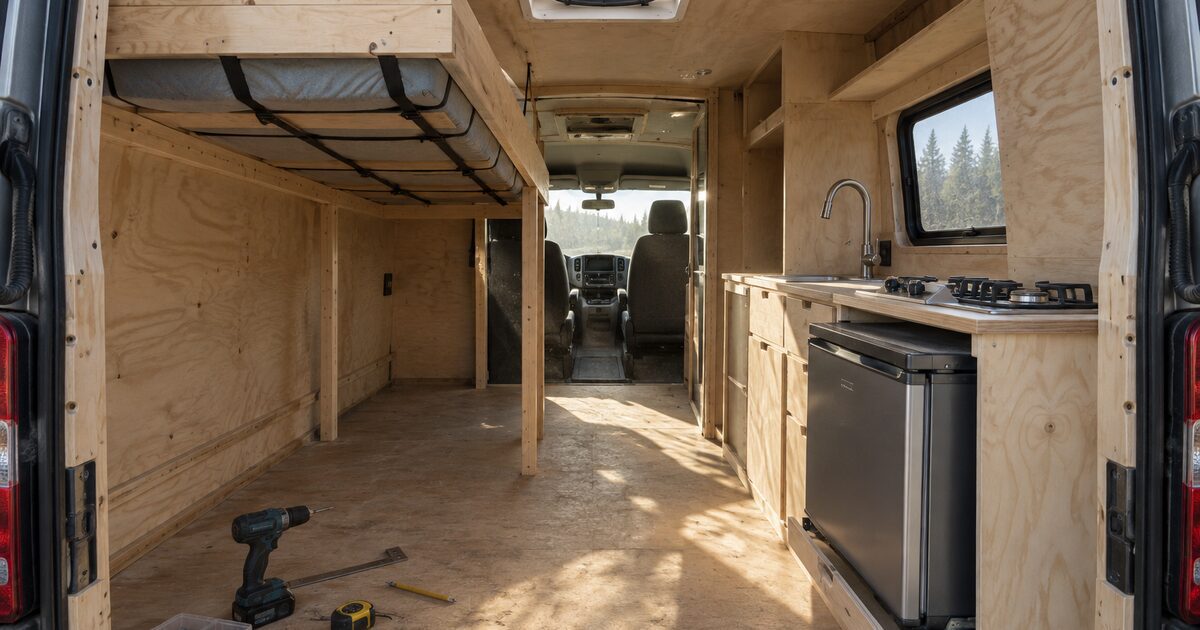
In a small box, floor area is the only real currency, and a bed platform that cranks or lifts to the ceiling turns a fixed bedroom into a living room or a workshop. Build it light: a plywood-and-rib frame with a foam mattress beats a folding steel mechanism that rattles at every expansion joint.
Nothing else returns as much comfort per dollar as a thermostatted roof vent fan. It moves hot air out of a van faster than any window combination and means you do not idle the engine to sleep in July. Cut once, seal it properly, and resist adding a second.
Vented heat is where I would spend real money. An unvented catalytic heater puts moisture and combustion products into the same small volume you are breathing, and in a rig with single-pane windows that moisture condenses on every cold surface by morning. A vented diesel or propane unit burns fuel and costs more, and it is the difference between a dry van and a mold problem. The moisture side of cold weather is covered in our winterizing walkthrough.
Two cassettes will last a solo traveler about a week, and emptying one at a restroom is a five-minute job instead of a drive to a dump station. You give up capacity and gain the ability to stay somewhere without planning your exit around a sewer connection.
The electrical upgrade that changes everything else is a DC-DC charger. Most first builds charge the house battery from the alternator through a relay, which works until the battery is deeply discharged and the alternator sees a load it was never sized for. A DC-DC unit isolates the two systems and charges at a controlled rate, which is what lets lithium take what it can take.
The five worth doing once the basics are in
Cold air stays where it is when you lift a lid, which is part of why a chest fridge cycles less in a hot van than an upright. Put it on a locking slide so it does not become a projectile.
One swivel base on the passenger seat turns dead cab space into the best seat in the house. The table should come out entirely, not fold down into a knee-bruising ledge.
Steel pegboard or a magnetic strip holds tools, spices and charging cables at a fraction of the weight of a plywood box with a door. It also lets you see what you own, which is the actual organizing problem in 60 square feet.
A shallow gray water tote under the sink that you carry out beats a plumbed underbody tank you have to drain, flush and winterize. It also makes where you dump an obvious physical act rather than an abstract one.
A layer of rigid insulation under the subfloor keeps the cold out of your feet and stops condensation forming under the mattress. Vinyl plank sweeps clean, tolerates a wet dog and does not grow anything, which carpet does all three badly.
What doesn’t survive a season
The list is consistent, and it is worth reading before you buy materials:
- Roof decks on a van. Several hundred pounds high up, a dozen holes in the roof, and a leak you will chase for years.
- Large skylights. Lovely for a week in spring, then a greenhouse from May to September.
- Tile, stone and butcher block counters. Weight exactly where you least want it, and nothing in a moving vehicle likes a rigid surface anchored to a flexing wall.
- A big inverter to run the air conditioner. The math rarely closes once you size the bank for a night of cooling.
- Converting a window van. You inherit glare, heat gain and condensation, and spend the build budget covering glass you paid for.
The payload budget nobody runs
Start with two definitions NHTSA has published for fifty years. Gross vehicle weight rating is the loaded weight the manufacturer specifies for the whole vehicle. Gross axle weight rating is the load-carrying capacity of a single axle system, measured at the tire-ground interfaces, and the sum of the axle ratings must at least equal the GVWR. Both appear on the certification label.
Now the rule that should worry every builder. When NHTSA wrote the cargo carrying capacity labeling requirement for motor homes and RV trailers, it required disclosure of any weight added before first retail sale above the lesser of 100 pounds or 1.5 percent of GVWR. On a 9,000-pound van, that is 135 pounds. The regulator decided a passenger and a duffel bag was enough to change a vehicle’s certified capacity, and your build will add thousands.
Water is the quiet one: a gallon weighs 8.34 pounds, so a 30-gallon fresh tank is about 250 pounds full, before the tank, pump and plumbing. Lead-acid batteries cost roughly twice the weight of lithium for the same usable capacity, and cabinetry in 3/4-inch plywood adds up faster than anyone expects. Fill the tank, load it, and weigh it at a CAT scale before your first trip. The scale ticket is the only honest document in the build.
What the codes cover, and what they don’t
A manufactured RV carries a seal because it was built and inspected against published standards. Those are the RV Industry Association’s adopted standards: NFPA 1192 for fuel systems, plumbing, and fire and life safety; the ANSI/RVIA DC standard, covering low-voltage systems up to 60 volts nominal; and the National Electrical Code for the 120-volt side. NFPA 1192 exists to protect occupants from fire and explosion, and the current edition is 2026.
Your self-built conversion is not certified against any of that. What you can do is buy components carrying a mark from a nationally recognized testing laboratory, which means the product was tested to a published safety standard and the maker was authorized to apply the mark. That is a real distinction from a badge on a marketplace page, and it matters most for anything that charges, inverts or burns fuel.
Where you park has rules too, and federal ones are stricter than most builds assume. BLM’s dispersed camping rules generally cap stays at 14 days in any 28-day period, and the agency states plainly that dispersed camping is for short-term recreation, not long-term living. If the plan involves staying put, the plan needs to change, and our beginner guide to boondocking covers the etiquette in more depth.
RV conversion FAQs
How much does an RV conversion cost?
Too wide a range to answer honestly, because the spread comes from labor and systems rather than materials. What is predictable is the order: insulation, heat, ventilation and electrical eat the budget before finishes do. Price the electrical and heating plan first, then see what is left.
How long does a van or trailer conversion take?
A first build by one person working weekends runs months, not weeks, and the electrical and heating work is where the schedule slips. Build the bed, the fan and a temporary power source first so the rig is usable, then finish it over a season.
Do I need to insulate a conversion?
Yes, and the ceiling matters more than the walls. Heat rises, and an uninsulated ceiling turns the box into a condensation trap the first cold night. Rigid foam under the floor and a thermal break under the mattress are the other two places that pay back.
Can I run an air conditioner off solar in a conversion?
Technically yes, practically it is the hardest load in the vehicle. Cooling draws more than any other appliance, so the bank and the array both have to be sized for the worst night of the year rather than the average afternoon. Most builds that claim it run it for an hour, not overnight.
Will my insurance cover a self-converted vehicle?
Not automatically, and this is the step most builders leave until the end. Conversions are commonly insured as modified or specialty vehicles, and insurers want documentation. Call before you cut a hole in the roof, not after, and get the requirement in writing.
Start with the bed and the fan
If you do only two things this month, make the bed lift and fit the vent fan. They cost little, weigh almost nothing, and change how the space feels every single day. Everything else can wait until you have slept in it.
Some links in this guide may be affiliate links. We keep them separate from sponsored content, and you can read how and why in our post on separating affiliate content from paid sponsorships. This is not professional advice — always confirm current rules with the relevant authority before you act on it.