How to Organize a Tiny Home Without Losing Your Mind
In a tiny home, a jacket on a chair can become a wardrobe, and yesterday’s mail can take over the only place to eat. You do not need to become a different person to get organized. You need storage that matches the way you use the space.
Start with the things you reach for every day, give them easy homes, and keep the routes between them clear. Then deal with the occasional items. Buying more containers before doing that often leaves you with the same problem in nicer boxes.
This guide applies to small fixed homes as well as homes on wheels. The travel and loading checks are specifically for an RV or a home being transported; they are not rules for every small dwelling.
Start with the part of the day that keeps going wrong
Choose one recurring irritation. Perhaps you move three things to make coffee, cannot find a charger, or have to clear the bed before sleeping. That is your first organizing project.
Empty that small area and separate its contents into four groups: used here, used elsewhere, ready to leave, and undecided. Put back only the first group. Take the second to its proper place now. Give donations an exit date instead of letting a bag become another permanent fixture.
For undecided belongings, a dated review box can help. Review it after a month, but do not discard everything automatically: seasonal clothing, documents, emergency supplies, and sentimental objects deserve a different test from an unused kitchen gadget.
Give daily life four practical zones
Zones do not need walls or matching baskets. They need a clear purpose and an amount of storage you can live with.
- Arrival: a hook for the bag, a small place for keys, and space for the shoes you use now.
- Cooking: the pans, utensils, and ingredients you reach for most, near the surface where you prepare food.
- Rest and clothing: accessible daily clothes and bedding, with occasional items farther back.
- Work and utilities: a defined place for chargers, paperwork, tools, and household supplies. Keep clean items separate from wet or dirty equipment.
A working limit might be one drawer for cables or one shelf for mugs. When it fills, compare what is already there before adding something. The limit should make decisions easier, not stop you from keeping equipment you genuinely need.
Match the storage to how often you open it
A bench with a lift-up seat may offer useful space. It is less useful for the kettle you need while someone is sitting there. Put frequent-use items where you can retrieve and replace them in one ordinary movement.
| Location | Useful for | What to check |
|---|---|---|
| Open shelf or accessible drawer | Daily items | Easy reach; secure contents before travel |
| Under a bed or bench | Occasional belongings | Access, dampness, and ventilation |
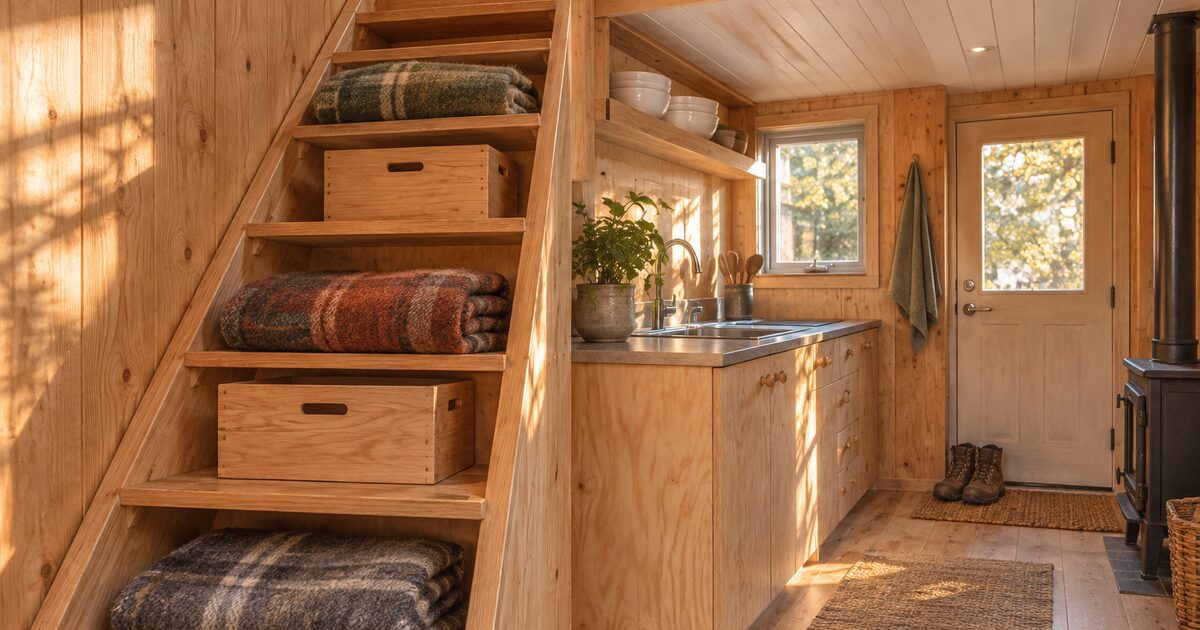
| Existing stair drawers | Shoes or small household items | Nothing protrudes into the walking route |
| High cupboard | Light items used less often | Safe reach, secure doors, and load limits |
| Approved exterior compartment | Suitable outdoor equipment | Manufacturer restrictions, moisture, and weight |
Measure the opening as well as the shelf. A container that fits inside a cupboard but will not pass through its door is not a bargain. Leave enough room to grip and remove it. Labels belong on the side you can see.
Before installing shelves or drilling into a wall, establish what is behind it and how the fitting will be supported. An organizing project should not damage wiring, plumbing, insulation, or a structural member.
If the home moves, check the loaded weight
A fitted cabinet still adds weight. So do books, tools, food, and water. The RV Safety & Education Foundation’s weight glossary distinguishes a trailer’s cargo carrying capacity from a motorhome’s occupant and cargo carrying capacity. Fresh water counts as cargo; the motorhome figure also includes occupants.
Water weighs approximately 8.3 pounds per US gallon, so 30 gallons adds about 249 pounds. That calculation is a useful reminder, not a complete loading assessment. Tank contents, installed accessories, axle and tire limits, and the tow vehicle’s ratings also matter.
Read the labels and manual for your particular vehicle and weigh it in its actual travel configuration. The Foundation’s weigh-report guidance explains why overall weight alone can miss an overloaded axle or wheel position. For a tiny house on a trailer, confirm the transport limits with its builder or a qualified specialist rather than assuming RV labels and definitions apply.
Keep heavy belongings in suitable secured locations according to the manufacturer’s loading guidance. An empty-looking overhead space is not a reason to fill it with heavy storage boxes.
Keep stored belongings dry
Under-bed storage does not automatically cause mold. Trouble develops when moisture goes unnoticed. Look for leaks, damp bedding, condensation, and items that were put away before they dried.
The EPA’s mold-prevention guidance recommends keeping indoor relative humidity below 60 percent, ideally between 30 and 50 percent where possible. It also recommends drying water-damaged materials within 24 to 48 hours to reduce the risk of mold growth.
A humidity meter helps you notice changing conditions. Inspect enclosed storage regularly, especially beside cold outside surfaces. Avoid packing soft items so tightly that you cannot inspect or dry the area. Address the source of dampness; depending on the conditions, that can involve repairing a leak, improving airflow, or dehumidifying. Ventilation alone is not the answer in every climate.
Seasonal bedding needs a dry, suitable location. An exterior compartment is not automatically appropriate just because it has room.
Keep the exit route out of the storage plan
The US Fire Administration’s RV guidance says to keep doors and windows clear for escape and make sure they open easily. It also recommends keeping a fire extinguisher within easy reach and practicing an escape plan.
Walk the route from the bed to the exit. Can you use it without moving a laundry basket or stepping over a bin? Check any emergency window as well. Do not store belongings where they obstruct alarms, appliance ventilation, or access to essential controls.
In a fixed tiny house, loft, stair, and escape requirements depend on the applicable local rules and the building’s approved design. Avoid turning guardrails or escape openings into storage space, and check proposed alterations with the local building department. A model-code diagram from another jurisdiction is not permission to modify your home.
Fuel, propane, and chemicals need their specified storage arrangements. Do not treat an ordinary utility bin or an added exterior box as a suitable fuel compartment.
Make shared surfaces easy to reset
A table can serve as a desk and a dining area if the work materials have somewhere to go. Try a slim tray or a small caddy that holds the notebook, charger, and papers together. At mealtime, move that one unit to its designated shelf instead of scattering its contents around the room.
The same idea works beside a bed or in a kitchen: group the things used together, but keep the group small enough to lift comfortably. A tray that becomes too heavy to move has stopped solving the problem.
Start with containers you own. Buy replacements only after the arrangement works for a week or two. That waiting period tells you whether you need a different box or simply fewer things in it.
A short weekly reset
Set aside a manageable amount of time once a week. Ten or fifteen minutes is a starting point, not a promise about how long every home takes.
- Return things that have drifted into the arrival area.
- Clear the shared table and put its work supplies away.
- Check one storage location for crowding or dampness.
- Remove rubbish and act on the donation bag.
- Change one arrangement that keeps frustrating you.
If the same item is always left out, ask why. Its assigned home may be too far away, awkward to open, or already full. Moving a hook can do more than another round of telling yourself to be tidier.
Common questions
How do I organize a tiny home without closets?
Combine a small hanging area with drawers or folded storage. Give the clothes you currently wear the easiest access. Measure your available space before buying a rail or wardrobe system.
Should I get rid of everything I rarely use?
No. Keep necessary safety equipment, records, and belongings that matter to you. Review duplicates and low-value clutter first. A small home needs deliberate choices, not a rule that treats every possession the same.
What should I organize first?
Start where clutter interrupts an everyday task. A clear coffee-making area or an accessible bed gives you a useful result immediately. Solve one area before emptying the whole home.
Make room for the life you want to live
The goal is to find your belongings, use your home comfortably, and put things away without a struggle. Start with one frustrating corner, give its everyday items a sensible home, and see how the arrangement works. A small change that lasts is worth more than a perfectly arranged cupboard nobody wants to open.
Related reading: Planning a mobile space? See 10 RV conversion ideas and the beginner’s guide to boondocking.